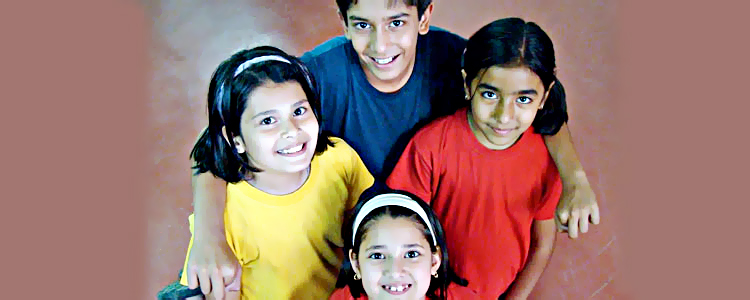
The transition from preschool to first grade is a significant step in a child's life. The physical changes alone, at this time, are striking. Children lose their baby teeth and their baby fat as their bodies lengthen, taking on a new proportion. When children enter the first grade, theu change inwardly as well. Their inner life deepens and their emotional response to the world around them becomes richer.
First graders are as physically active as they were during the kindergarten years, but now they must be taught in a manner that engages their growing emotional capacity. Waldorf teachers use a wide variety of methods to address this developing capacity, but in the grade school, the most significant is art. In a Waldorf School all subjects - language arts, geometry, chemistry, history, geography - are taught through art.
Right from the beginning of grade one, lessons are infused with an imaginative, aesthetic quality. Even the letters of the alphabet are taught in an artistic way. If, for example, the letter S is being introduced, the children might be told a story of a snake - a sly and slinking serpent with a sinuous shape.
This snake will be described in all its subtlety as it slithers and hisses through the softly stirring grass. The alliteration will bring a phonemic awareness to the children. On the blackboard the teacher will draw a beautiful picture of a snake in coloured chalk to accompany the story.
Waldorf Schools do not waste much time debating the respective values of the sight and sound methods of reading. They use both, and more. But, their uniqueness lies in the way they release the inherent power of the miraculous word from the humdrum of conventional speaking, writing and reading.
The task of educating children in this comprehensive, artistic manner - using poetry, music, painting, drawing, and drama - is the assignment of the class teacher. In each Waldorf school the class teacher is given the primary responsibility of shepherding the children in his or her class through the eight years of elementary school. Through this on-going relationship, the emotional bond between the teacher and the children is strengthened, allowing the teacher to know both the children and their families more deeply. In contemporary society, where families are increasingly transient and where extended families are not always nearby, Waldorf Schools provide a much-needed, ongoing sense of community.
The class teacher is supported in these efforts by an equally dedicated group of specialty teachers, individuals who work with the children throughout the grades in a variety of subjects: music, handwork, woodwork, physical education, and more. The insights and understandings of these teachers complement those of the class teacher to ensure that each child is known fully and taught in a manner that addresses his or her educational needs.
Over this extended eight-year journey, the class teacher and the specialty teachers will observe many dramatic developmental changes in the children. For instance, one notable juncture will occur around the age of nine or ten. At this time children become more individuated and independent. This individuation is accompanied by a sense of separateness that gives rise to self-consciousness. Perhaps, the most obvious way in which the curriculum addresses the nine-year change is through the stories that are told in the course of the school year.
Other parts of the third grade curriculum are designed to help the nine-year old with this transition, as well. One feature of this change is that children begin to experience uncertainty. They are unsure of their surroundings and begin to question and to be afraid. The third grade study of house building corresponds to a child's need to find stability in the world. This confidence is furthered by the study of how a modern house is constructed. The children can feel the solidity of the foundation, the firmness of the floor joists, and the uprightness of the stud walls. Children at this age have a great interest in all that people can do with their hands and are fascinated by the plumbers, electricians, roofers, and painters. They come to sense their own potential and understand that they too can do. This feeling is empowering. It works to allay fears and to quell insecurities.
For the ten-year-old child, the world begins to expand. So in fourth grade geography is introduced to correspond to the children's growing interest in the neighborhoods in which they live. This initial study of geography helps children begin to orient themselves, gradually reaching out from the neighborhood to the towns, cities, provinces, and countries of the earth. This study will be continued and expanded each year through eighth grade until the children have a thorough understanding of the vastness and diversity of our planet.
In sixth grade, for instance, the teaching of geometry mirrors the adolescents growing need and affinity for precision. The geometric constructions that are done in class with serious mechanical drawing tools support the acquisition of new skills and new understandings. Terms like circumference, radius, diameter, perpendicular, and parallel become meaningful through hands-on constructions. These constructions are intricate and demanding, combining technical accuracy with artistic ability. This is an unbeatable combination for the twelve year-old: engaging them fully while enabling them to work with marked focus and uncharacteristic quiet. The result is the acquisition of technical skill and know-how that is lasting and sound.
In seventh grade, the historical study of the Renaissance is the perfect subject for the thirteen year-old. At a time when young people are ready to redefine themselves, leave their early grade experiences behind and look to the future, they resonate with the changing world of Michelangelo, Leonardo, and Copernicus. Old ideas and ways of thinking have lost immediacy and power for the seventh grader. In history classes, as in all subjects, the students create their own textbooks. They write compositions to summarise in a clear and concise manner the important information that has been studied and carefully illustrate their work through demanding modes of self-expression.
In seventh and eighth grade, science studies reflect a young person's growing preoccupation with his or her physical body. Whether the subject is human physiology with a study of the circulatory, digestive, and reproductive systems, or the anatomy of the skeletal system, the students are captivated by this work in a way that could not have been possible prior to puberty.
Throughout the grade school, the students experience a deep spectrum of feelings as they are taught in a manner that nurtures both their affective and cognitive capacities. They delight, wonder, and are surprised by the subjects they study. They relive the development of western civilisation and come to a deeper understanding of what it means to be human.